
Why Smart Property Owners Choose Preventative Maintenance Programs
Preventative maintenance programs are scheduled systems of inspections, repairs, and upkeep designed to keep your building’s critical components functioning before they fail. Instead of waiting for costly emergencies, these programs help you maintain roofs, HVAC systems, and other essential infrastructure through regular, planned care.
Quick Answer for Creating Your Maintenance Plan:
- Inventory your assets – List all critical building systems (roof, HVAC, plumbing, electrical)
- Assess criticality – Prioritize based on safety, operations impact, and replacement cost
- Schedule tasks – Set inspection and maintenance frequencies based on manufacturer guidelines
- Assign responsibilities – Designate team members or contractors for each task
- Track and measure – Monitor completion rates and equipment performance
- Adjust as needed – Refine schedules based on results and changing conditions
Research shows that preventative maintenance can reduce lifecycle costs by 12-18%. Companies implementing structured programs report impressive results: 32% reduction in unplanned downtime, 37% increase in mean time between failures, and 34% reduction in parts inventory costs.
The shift from reactive to preventative maintenance transforms how you manage your property. Instead of dealing with emergency roof leaks, HVAC failures, or structural damage during storms, you catch problems early when they’re cheaper and easier to fix.
As one facilities expert puts it: “Preventive maintenance and planning fit together perfectly, just like salt and pepper, Batman and Robin, and movies and popcorn.” The connection is simple – good planning prevents expensive surprises.
For property owners in storm-prone areas, this approach is especially critical. Regular roof inspections and maintenance can prevent small issues from becoming major problems during severe weather events.
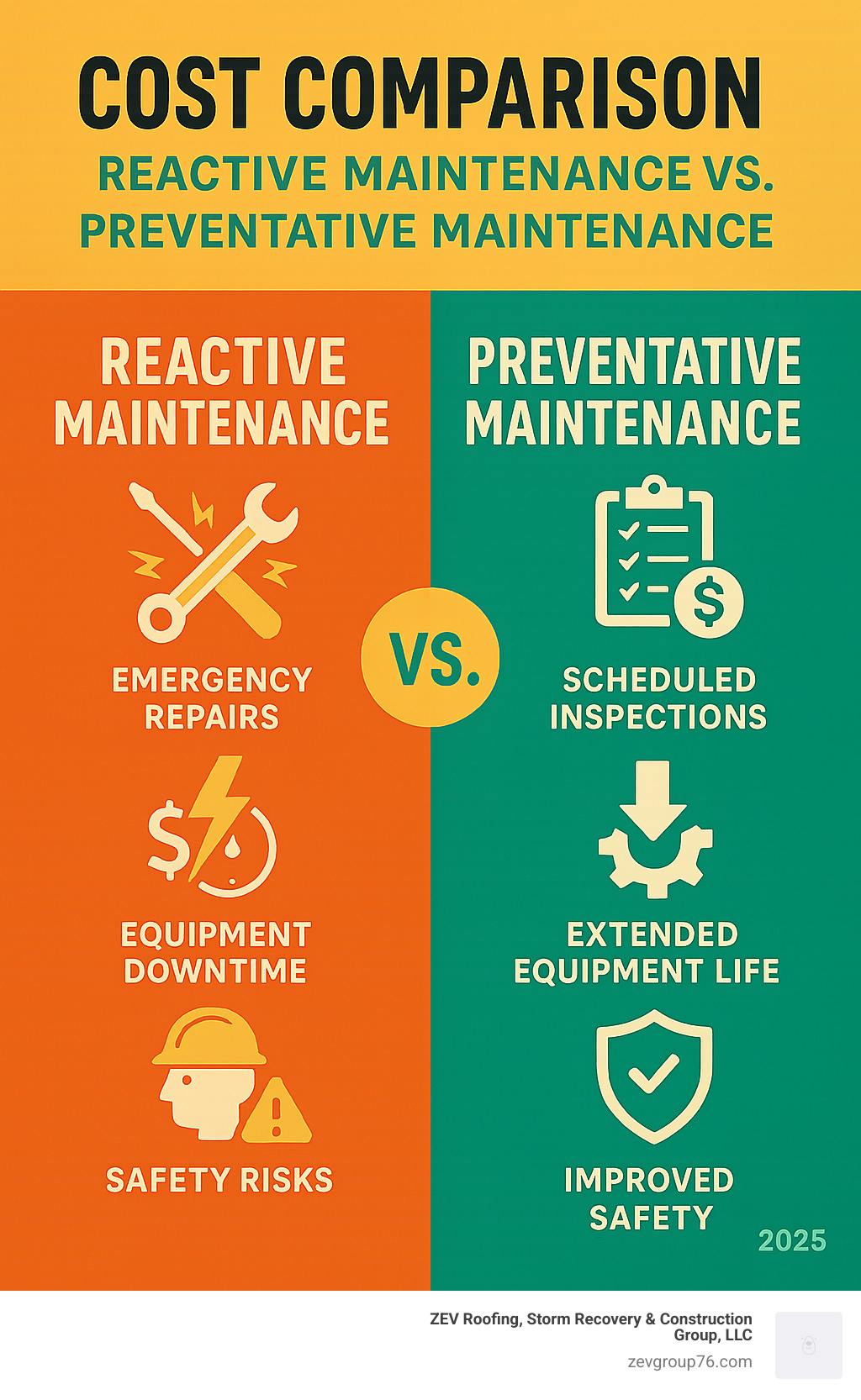
What Are Preventative Maintenance Programs and Why Do They Matter?
Think of preventative maintenance programs as your property’s health insurance plan. Just like you wouldn’t skip your annual doctor’s visit, your building needs regular check-ups too. At ZEV Roofing, Storm Recovery & Construction Group, we’ve seen how this simple shift in thinking can save property owners thousands of dollars and countless sleepless nights.
The magic happens when you move from reactive to proactive thinking. Instead of scrambling to find emergency roof repair contractors at 2 AM during a Texas thunderstorm, you’re confidently weathering the storm knowing your roof was inspected and maintained just last month. That’s the difference between crisis management and smart property ownership.
Here’s what gets us excited about preventative maintenance: the financial benefits are real and measurable. Research consistently shows that these programs reduce lifecycle costs by 12-18%. That’s not just fancy industry talk – it means more money staying in your pocket instead of going to emergency repair bills.
But the benefits go beyond your wallet. Operational stability becomes your new normal. Your HVAC system keeps humming along smoothly. Your roof stays watertight season after season. Your tenants stay happy, and your stress levels stay manageable. It’s about creating predictability in an unpredictable world.
And let’s talk about safety culture for a moment. Regular maintenance isn’t just about avoiding expensive repairs – it’s about protecting people. When we catch that loose flashing before it becomes a flying projectile in a windstorm, we’re not just saving your roof. We’re keeping your family, employees, and neighbors safe.
The Core Goal: Preventing Failure Before It Starts
Here’s the beautiful simplicity of preventive maintenance: stop problems before they start. It’s like that old saying about an ounce of prevention being worth a pound of cure, except in construction, it’s more like an ounce of prevention being worth a ton of headaches.
Defining preventive maintenance is straightforward – it’s taking care of things while they’re still working well. Think of it as giving your building systems the attention they deserve before they demand it through dramatic failures.
Routine inspections are the backbone of any good program. We’re talking about regular walk-throughs where trained eyes look for the small stuff: a loose shingle here, a clogged drain there, or a worn seal that’s asking for trouble. These aren’t glamorous moments, but they’re the ones that save the day.
Scheduled servicing takes it a step further. This is when we clean, adjust, lubricate, and fine-tune your building systems on a calendar that makes sense. Your HVAC gets its seasonal tune-up. Your gutters get cleared before storm season. Your roof gets its annual physical.
The payoff? Extending equipment life becomes automatic. A well-maintained roof can last decades longer than one that’s ignored. HVAC systems purr along for years beyond their expected lifespan when they’re properly cared for.
Most importantly, you’re avoiding costly emergency repairs. No more panicked calls about water pouring through the ceiling. No more weekend emergency service charges that cost triple the normal rate. When storms hit and you need storm damage repair, you’re dealing with genuine storm damage, not pre-existing problems that got exposed by bad weather.
Preventive vs. Predictive vs. Reactive Maintenance
Let’s clear up some confusion about maintenance approaches. Think of them like three different ways to handle your car: you can wait until it breaks down on the highway, follow the maintenance schedule in your owner’s manual, or install fancy sensors that tell you exactly when each part needs attention.
Reactive maintenance is the “fix it when it breaks” approach, and honestly, it’s exhausting. Everything becomes an emergency. Costs skyrocket because you’re always paying premium prices for urgent service. Your equipment lives a shorter, more stressful life, and so do you.
Preventive maintenance – our favorite – follows a sensible schedule. We service things based on time intervals or usage patterns, regardless of whether they seem to need it. It’s planned, it’s predictable, and it works beautifully for most property owners.
Predictive maintenance is the high-tech cousin that uses condition-based monitoring. Sensors and smart systems watch your equipment’s vital signs and predict when maintenance is needed. It’s impressive technology, but most buildings don’t need this level of sophistication to see dramatic improvements.
| Approach | When It Happens | Cost Level | Technology Needed | Labor Requirements |
|---|---|---|---|---|
| Reactive | After equipment fails | High (emergency rates, damage) | Basic repair tools | Rushed, often overtime |
| Preventive | Scheduled intervals | Moderate (planned investment) | Checklists, scheduling | Planned, efficient |
| Predictive | Based on equipment condition | Lower long-term | Sensors, analytics software | Highly targeted |
The sweet spot for most property owners? A solid preventative maintenance program that catches problems early, keeps costs predictable, and lets you sleep soundly knowing your building is in good hands. It’s not the fanciest approach, but it’s the one that consistently delivers results you can count on.
Building Your Blueprint: 4 Steps to an Effective Maintenance Plan
Creating a successful preventative maintenance program can feel overwhelming, but it doesn’t have to be. The process requires strategic planning, a clear implementation framework, smart resource allocation, and thorough documentation.
We’ve helped countless property owners in Texas and New Mexico develop maintenance programs that work. The key is breaking it down into manageable steps and staying committed. When done right, your maintenance program becomes the backbone that keeps your property running smoothly, even when Mother Nature has other plans.

Let’s walk through the four essential steps to transform your maintenance approach from chaotic to systematic.
Step 1: Inventory and Prioritize Your Assets
You can’t protect what you don’t know you have. This first step is foundational: creating a comprehensive asset inventory.
Start with the big players – your roof, HVAC systems, water heaters, and electrical panels. But don’t stop there. Include sump pumps, fire suppression systems, and specific sections of plumbing. For each asset, capture the essentials: manufacturer details, model numbers, installation dates, and current condition.
Next, a criticality analysis helps you prioritize. Ask: What happens if this fails? What’s the replacement cost? What are the safety risks?
Your roof typically tops this list for good reason. A failing roof can shut down operations, damage inventory, and create safety hazards. HVAC systems also rank high, especially in our Texas heat. Even components like More info about Exterior Siding play crucial roles in protecting your building’s envelope.
Use manufacturer recommendations and maintenance history to guide your decisions. Past failures are excellent teachers for future prevention. The goal is to focus your efforts where they’ll have the biggest impact.
Step 2: Develop and Schedule Maintenance Tasks
This step transforms your asset list into actionable plans with detailed task checklists for each piece of equipment.
These checklists are recipes for success. For roofs, this might include inspecting shingles, checking flashing, and clearing gutters. HVAC units need filter changes and coil cleaning. The key is making checklists detailed enough for consistent execution by anyone on your team.
Determining task frequency follows two paths. Time-based triggers work best for most building systems, like annual roof inspections or quarterly HVAC maintenance. Usage-based triggers apply to equipment with heavy use, like vehicles or machinery.
Source this information from manufacturer guidelines, your maintenance history, and industry best practices. Experienced professionals like our team at ZEV Roofing also bring real-world insights.
Resources like best practices for determining the frequency of preventive maintenance inspections can help fine-tune your schedules. These frequencies aren’t set in stone; you’ll adjust them as you learn. Components like More info about Gutter Installation might need more frequent attention in areas with heavy tree coverage.
Step 3: Delegate, Train, and Execute
A great plan is useless without proper execution. This step focuses on the human side: ensuring the right people do the right things with the right knowledge.
Assigning responsibilities means getting crystal clear about who does what. Your in-house team might handle routine inspections while certified contractors tackle specialized equipment. For safety-critical systems, ensure qualified professionals do the work. Clear ownership prevents tasks from falling through the cracks.
Team training makes or breaks your program. Your people need to understand proper procedures, safety protocols, and how to use new tools. It’s also crucial to explain the “why” behind each task. When technicians understand how their work prevents costly failures, they take more pride in doing it right.
Well-trained technicians can solve 90% of facilities management issues faster and cheaper than emergency specialists—a clear return on investment.
Stakeholder buy-in extends beyond your maintenance team. Management needs to see the strategic value, and finance needs to see the ROI. Share success stories and involve key people in planning to build support.
The execution phase is where you follow schedules, complete checklists, and perform routine tasks. Documenting everything creates a valuable history for each asset, proving your program’s effectiveness.

Step 4: Overcoming Common Implementation Challenges
Implementing a preventative maintenance program has its challenges, but knowing what to expect helps you steer them.
Budget constraints are a common objection. To overcome this, frame maintenance as an investment. Show decision-makers the 12-18% lifecycle cost reduction, calculate avoided emergency costs, and demonstrate how it delays major capital expenditures.
Lack of buy-in can sink your program. You need champions at every level. Involve key stakeholders in planning, share success stories from similar properties, and celebrate early wins to build momentum.
Poor data makes smart decisions impossible. Without accurate records, you’re guessing at priorities. Start collecting data immediately, even if it’s basic. Consistent record-keeping is the foundation for improvement.
Resistance to change is natural. Counter it with training, clear communication, and involving technicians in developing procedures. When people help create the plan, they’re more likely to support it.
Feeling overwhelmed by trying to do everything at once can kill a program. Start small with your most critical assets, learn from a pilot program, and then expand gradually.
Preventative maintenance programs are long-term investments. You won’t see immediate dramatic returns, but you will avoid budget-busting emergency repairs. Patience and consistency win this game.
How to Boost Your Preventative Maintenance Programs
Once your foundational preventative maintenance program is in place, there are powerful ways to improve its effectiveness, making it more efficient, data-driven, and ultimately, more successful. This involves leveraging technology, empowering your team, and committing to continuous improvement based on solid data.
The Role of Technology and CMMS Software
Technology is no longer a luxury but a necessity for optimizing maintenance operations. A Computerized Maintenance Management System (CMMS) is the backbone of a modern, efficient preventative maintenance program. It’s a software solution that centralizes all your maintenance information and streamlines workflows.
Here’s how a CMMS can boost your program:
- Work Order Management: Create, assign, track, and close work orders digitally. This ensures nothing falls through the cracks.
- Automated Scheduling: Set up recurring tasks for preventative maintenance based on time or usage. The CMMS automatically generates work orders when they’re due, ensuring consistency.
- Mobile Access: Technicians can access checklists, view asset history, and log work directly from their mobile devices in the field, making data capture easy and accurate. This allows them to use pre-filled templates, track time, and even capture signatures.
- Reporting and Analytics: A CMMS collects vast amounts of data. It can generate reports on asset availability, costs, failure causes, and key performance indicators (KPIs). This data helps you analyze trends, adjust schedules, and refine your strategies.
- Inventory Management: Track spare parts and materials, ensuring you have what you need when you need it, and reducing parts inventory costs (companies using MaintainX report a 34% reduction).
- Digital Audit Trails: For compliance with regulations (like OSHA, EPA, FDA), a CMMS provides a comprehensive digital history of all maintenance activities, streamlining audits.
Companies using CMMS solutions like MaintainX report impressive results, including a 49% improvement in planned maintenance percentage, a 32% reduction in unplanned downtime, and a 37% increase in Mean Time Between Failures (MTBF). This clearly demonstrates the tangible benefits of integrating such technology into your operations. If you’re looking to get more done, explore options like MaintainX.
The Human Element: Stakeholder Buy-in and Team Training
While technology is a powerful enabler, the success of any preventative maintenance program ultimately rests on the people behind it. The human element – buy-in, training, and a proactive culture – is critical.
- Importance of a Proactive Culture: This isn’t just about implementing a new process; it’s about shifting mindsets. A proactive culture means everyone, from leadership to the frontline technicians, understands and values the importance of preventing issues rather than just reacting to them. As one expert noted, “Preventive maintenance must be acceptd as the foundation of a facilities management program, or time will not be made for it.”
- Training on New Processes and Software: Even the best CMMS is useless if your team doesn’t know how to use it. Comprehensive training is essential. This includes not just technical skills for maintenance tasks, but also training on how to use any new software, follow digital checklists, and accurately document their work. Hands-on training, perhaps in a simulated environment, can be incredibly effective.
- Involving Technicians in Plan Development: Your frontline technicians are the experts on your equipment. Involving them in the development of maintenance plans and checklists can uncover practical insights that data alone might miss. Their buy-in and ownership are invaluable.
- Communicating Goals and Results: Regularly communicate the program’s goals and, more importantly, its successes. Share KPIs, highlight reductions in downtime, and celebrate extended equipment life. This reinforces the value of their efforts and motivates continued adherence to the program.
- Boosting Employee Retention: A well-managed preventative maintenance program can actually boost employee retention. When technicians are engaged in meaningful, proactive work rather than constantly fighting fires, job satisfaction can increase. This leads to a more stable, skilled workforce, which is a huge asset.
Technology supports the people, but it doesn’t replace them. A strong, well-trained team, committed to the program’s success, is the true engine of an effective preventative maintenance program.
Measuring Success: Key KPIs for Your Program
Think of your preventative maintenance program like tending a garden. You wouldn’t just plant seeds and hope for the best – you’d measure rainfall, check soil conditions, and track which plants are thriving. The same principle applies to maintaining your property’s critical systems.
Without solid data analysis and performance tracking, you’re essentially flying blind. How do you know if your roof inspections are actually preventing leaks? Are your HVAC maintenance schedules keeping systems running smoothly? The only way to prove your return on investment and identify areas for improvement is through careful measurement. For critical components like your roof, regular More info about Roof Inspection forms a key part of this measurement process.
We’ve learned that companies using structured maintenance programs see remarkable results. But here’s the thing – those results only come when you’re tracking the right metrics and using that information to make smart decisions.
Essential KPIs for Preventative Maintenance Programs
Key Performance Indicators give you concrete targets and show whether your program is actually working. It’s like having a report card for your maintenance efforts. Without establishing these concrete targets, you’re just guessing about success.
Planned Maintenance Percentage (PMP) is one of the most telling metrics. This measures how much of your maintenance work is planned versus reactive. When you’re constantly putting out fires, your PMP is low. But as your preventative maintenance program takes hold, you’ll see this number climb. Companies using structured systems report a 49% improvement in PMP – that’s a game-changer for any property owner.
Mean Time Between Failures (MTBF) tells you how long your equipment runs without breaking down. Think of it as your equipment’s endurance score. When your preventative efforts are working, this number keeps climbing. We’ve seen companies achieve a 37% increase in MTBF once they implement effective maintenance systems.
PM Compliance is your accountability measure. It tracks whether your scheduled maintenance tasks are actually getting done on time. High compliance means your team is consistently executing the plan – no skipped inspections or delayed services.
Maintenance Backlog shows you the volume of pending work. A manageable backlog indicates you’re staying ahead of issues rather than falling behind. When backlogs grow too large, it’s often a sign that you need more resources or better scheduling.
The Emergency vs. Planned Work Ratio reveals the balance between crisis management and proactive care. Your goal is to dramatically shift toward planned work, reducing those costly middle-of-the-night emergency calls. Nothing ruins a weekend quite like an unexpected roof leak or HVAC failure.
Using Data to Refine and Improve Your Plan
Collecting numbers is just the starting point. The real magic happens when you analyze trends and use those insights to make your program even better.
Analyzing KPI trends means looking beyond individual snapshots to see the bigger picture. Are your planned maintenance percentages climbing month over month? Is your equipment lasting longer between failures? These trends tell the story of your program’s success and highlight areas that need attention.
When equipment does fail despite your preventative efforts, that’s when Root Cause Analysis (RCA) becomes invaluable. We dig deep to understand why the failure occurred. Was the maintenance frequency insufficient? Did a specific task get missed? Sometimes we find that a particular component has a design flaw or that environmental factors are more severe than anticipated. These investigations help you adjust your maintenance schedules and tasks to prevent similar issues.
Adjusting maintenance frequency based on your data analysis is where the program really starts to shine. You might find that some assets need more frequent attention – perhaps your roof needs quarterly inspections instead of annual ones in a particularly harsh climate. Conversely, other equipment might be over-maintained, allowing you to extend intervals without increased risk.
Optimizing resource allocation becomes much easier when you have solid data. You can see where your maintenance team’s time is most effective and identify areas where resources might be stretched thin or underused. This leads to better staffing decisions and more balanced workloads.
Perhaps most importantly, your data becomes powerful ammunition for justifying budget requests. When it’s time to request funds for new equipment, software, or additional staffing, you’re not just asking – you’re presenting compelling evidence. You can demonstrate exactly how your preventative efforts save money, extend asset life, and contribute to your property’s overall health and value.
The beauty of a well-measured preventative maintenance program is that it becomes a living, breathing strategy that continuously improves. Your data guides decisions, prevents waste, and ensures every dollar spent on maintenance delivers maximum value for your investment.
Conclusion
Creating a successful preventative maintenance program isn’t just about following a checklist – it’s about fundamentally changing how you think about your property. Throughout this guide, we’ve walked through the change from that stressful “fix-it-when-it-breaks” approach to a calm, confident strategy where you’re always one step ahead of problems.
The numbers speak for themselves. Reducing lifecycle costs by 12-18% while extending the life of your most valuable assets? That’s not just smart business – it’s peace of mind. When you shift from reactive scrambling to proactive planning, you’re not just saving money. You’re protecting your investment, ensuring your family or tenants stay comfortable, and avoiding those middle-of-the-night emergency calls that nobody wants to deal with.
We’ve seen how effective these programs can be, especially here in Texas and New Mexico where severe weather can turn a small maintenance issue into a major disaster overnight. A loose shingle that could have been spotted during a routine inspection becomes a major leak during a storm. A clogged gutter system that seemed harmless suddenly causes water damage to your foundation.
The four-step blueprint we’ve outlined – inventorying your assets, developing maintenance schedules, training your team, and measuring success – isn’t complicated, but it does require commitment. The good news? You don’t have to tackle everything at once. Start with your most critical systems, build momentum with small wins, and expand from there.
Technology like CMMS software can make the process smoother, but the human element is just as important. Your maintenance team, whether internal or external partners like us, needs to understand not just the “what” but the “why” behind each task. When everyone’s on board with the preventative mindset, that’s when the magic happens.
At ZEV Roofing, Storm Recovery & Construction Group, LLC, we’ve built our reputation on understanding that prevention is always better than cure. Whether it’s a commercial roof that needs regular inspections or residential siding that requires seasonal maintenance, we know that consistent care today prevents expensive emergencies tomorrow.
Your building’s roof, in particular, is your first line of defense against everything Mother Nature throws at it. For comprehensive protection and to ensure the durability of your building’s most critical assets, a robust maintenance plan is your best defense. Start building your strategy for ultimate More info about Leak Prevention.
The investment you make in a preventative maintenance program today will pay dividends for years to come. Your future self will thank you for taking this proactive step – and your wallet will too.